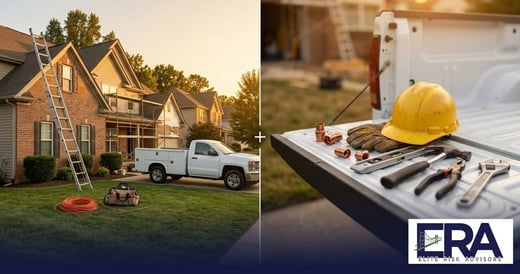
If a vehicle does any work for your Owensboro business — hauling tools, making deliveries, driving to a job site — your personal auto policy may not cover it when it matters. That is the quiet gap most small business owners do not find until a claim gets denied. Commercial auto insurance closes it, and in Kentucky the requirements are more involved than most people expect.
This is a plain-English guide to commercial auto insurance for Owensboro businesses: what it is, when you need it, what Kentucky actually requires, and what drives the price. We are an independent agency that writes commercial auto in-house, so we will keep this practical.
Key Takeaways
- If a vehicle is used for business, a personal auto policy can deny the claim. Commercial auto exists for exactly that exposure.
- Kentucky's baseline commercial auto requirement is 25/50/25 liability plus $10,000 PIP — and Kentucky is one of the few states where PIP applies to commercial policies by default (MoneyGeek).
- Operating for hire under a Kentucky motor carrier certificate raises the floor sharply — 100/300/50 for property vehicles of 18,000 lbs or less, and 100/600/50 above 18,000 lbs (KRS 281.655). A truck your business owns and drives for its own work is not on that table.
- Interstate cargo haulers face a $750,000 combined single limit, and hazmat can run to $5 million (MoneyGeek).
- The state minimum is rarely enough for a business — an at-fault commercial wreck can exceed those limits and reach your business assets.
- Commercial auto should be written alongside the rest of your business coverage, not bought in isolation.
What Is Commercial Auto Insurance — and How Is It Different From Personal Auto?
Commercial auto insurance covers vehicles used for business purposes. That sounds obvious until you see how narrowly a personal policy defines "personal." Your personal auto policy is written on the assumption the vehicle is used for commuting and errands. The moment it is used to earn money — carrying equipment, hauling inventory, driving between job sites, transporting clients — you have stepped outside what that policy was built to cover, and the insurer can deny a claim on those grounds.
That is the whole reason commercial auto exists. It is priced and written for business use, with higher liability limits, coverage for the people who drive your vehicles, and options for the equipment and cargo you carry. The vehicle can be a fleet of trucks or a single work van. The dividing line is not how many vehicles you own. It is what they are doing.
Does Your Owensboro Business Need Commercial Auto?
If any of these are true, the answer is almost certainly yes. You or your employees drive to job sites or client locations. You haul tools, equipment, product, or materials. You own vehicles titled to the business. You have employees who drive for work, even in their own cars. You transport anyone or anything for a fee.
The trap is the "personal" truck that quietly does business work. A contractor's pickup, a caterer's van, a real estate agent's car full of signs — these live in a gray area their owners rarely think about until there is a wreck on the way to a job. If the vehicle was working when it crashed, a personal policy is exactly the wrong thing to be holding.
Kentucky's Commercial Auto Requirements
Every registered commercial vehicle in Kentucky must carry liability insurance, and the required limits depend on how the vehicle is used, not on weight alone (KRS 281.655). Here is how that ladder works.
The baseline is the same split you see on personal policies: $25,000 per person and $50,000 per accident for bodily injury, $25,000 for property damage, plus $10,000 in personal injury protection (PIP). Kentucky is unusual here — it is one of the few states where PIP applies to commercial policies by default.
From there it depends on what the vehicle is doing. If you operate for hire under a Kentucky motor carrier certificate, KRS 281.655 sets the floor at 100/300/50 for property vehicles of 18,000 pounds or less and 100/600/50 for anything heavier (KRS 281.655). A truck your business owns and drives for its own work is not on that table and stays at the standard Kentucky minimum. If you haul cargo across state lines in a vehicle over 10,001 pounds, federal rules push you to a $750,000 combined single limit, and high-risk hazardous materials can require $5 million. Most Owensboro small businesses live at the lighter end of that ladder — but knowing where your vehicles fall on it is the difference between being properly covered and being unpleasantly surprised.
And as with personal auto, the legal minimum is a floor, not a recommendation. A serious at-fault accident in a work vehicle can blow past these limits, and when it does, the business — its accounts, its equipment, sometimes its owner personally — is what covers the rest.
What Commercial Auto Covers
A commercial auto policy is built from the same core parts as a personal one, sized for business risk. Liability covers the injuries and property damage you cause to others. Physical damage — collision and comprehensive — covers your own vehicles. Medical and PIP coverage handles injuries to you and your drivers. And two coverages matter more for businesses than most owners realize: hired and non-owned auto (which covers vehicles you rent or employees' personal cars used for work) and uninsured/underinsured motorist, for the wreck caused by someone carrying nothing.
That hired-and-non-owned piece is the one that catches people. If an employee runs a work errand in their own car and causes an accident, your business can be pulled into the claim. A commercial policy can be built to cover that. A personal policy never will.
What Affects Your Commercial Auto Quote
Commercial auto pricing comes down to risk, and the honest list of what drives it is: the vehicles themselves (type, weight, value), how far and how often they are driven, what they carry, who drives them and their records, where they operate, and the liability limits you choose. A clean driving history across your team and a sensible safety program help. So does working with an agency that knows which carriers price your specific kind of operation well — because commercial auto rates vary widely by the nature of the business, and shopping it across companies is the only way to know you are getting a fair number.
How Commercial Auto Fits the Rest of Your Business Insurance
Commercial auto is one piece of a business's protection, and it should not be bought in a vacuum. Your vehicles, your general liability, your property and equipment, and your workers all create exposures that overlap. An agency that writes your commercial auto alongside the rest can see where coverage doubles up and where it leaves a gap — the trailer that is not scheduled, the tools stolen out of the truck, the employee driving uninsured. Bought piece by piece from different places, those gaps are exactly what nobody catches until a claim.
How Elite Risk Advisors Handles Commercial Auto in Owensboro
We write commercial auto in-house, and we start the way we start everything — with questions, not a quote. What do your vehicles actually do, who drives them, what do they carry, and where does the business itself sit exposed? Then we build the coverage across the carriers we represent and look at it next to the rest of your business insurance, so nothing important falls between two policies. We work with businesses across Owensboro and the surrounding towns — Hawesville, Lewisport, Livermore, Calhoun, Beaver Dam, Hartford, Central City, Greenville — and when you call, you reach us.
And if your current commercial coverage is already right for how you operate, we will tell you that, too. We would rather give you a straight answer than move you for the sake of it. That just isn't an Elite way of doing business.
If you are not sure whether your business vehicles are properly covered, that is exactly what a free review is for. Get one at www.eliteriskagent.com/get-a-quote — no sales pitch, no pressure.
FAQs About Commercial Auto Insurance in Owensboro
Do I need commercial auto insurance for my small business in Owensboro?
If a vehicle is used for business — hauling equipment, making deliveries, driving to job sites, or titled to the business — you almost certainly do. Personal auto policies exclude most business use and can deny a claim when a vehicle is being used for work. Elite Risk Advisors writes commercial auto in-house and can tell you exactly where your operation stands.
What are Kentucky's commercial auto insurance requirements?
Every registered commercial vehicle must carry liability, starting at 25/50/25 plus $10,000 PIP. Higher limits apply once you operate for hire under a Kentucky motor carrier certificate — KRS 281.655 requires 100/300/50 for property vehicles of 18,000 pounds or less, and 100/600/50 above that (KRS 281.655). Interstate cargo haulers face a $750,000 combined single limit. The minimum is rarely enough to protect a business.
Will my personal auto policy cover business use?
Usually not. Personal auto is written for personal use, and once a vehicle is working for the business, the insurer can deny the claim. That gap is the single most common reason Owensboro business owners end up paying for a wreck out of pocket.
What does commercial auto insurance cost for a small business?
It depends on your vehicles, what they carry, how far they drive, who drives them, and your coverage limits — commercial rates vary widely by the type of business. Because of that variation, shopping it across multiple carriers is the only reliable way to get a fair price, which is what an independent agency does for you.
Does commercial auto cover employees who drive their own cars for work?
It can, through hired and non-owned auto coverage. If an employee causes an accident while running a work errand in their personal vehicle, your business can be pulled into the claim — and only a commercial policy built to include that exposure will respond.
Related reading
Elite Risk Advisors is an independent insurance agency in Owensboro, Kentucky. We represent Erie, Progressive, Branch, Openly, Geico, and National General, and we work for you — not any single carrier.
Related coverage